01 / SENSORY
Afferent pathways
Sensory pathways carry information from peripheral receptors toward the central nervous system.
Move beyond the brain and spinal cord and explore the network that connects the central nervous system with the rest of the body.
The peripheral nervous system includes neural structures outside the brain and spinal cord. These structures connect the central nervous system with sensory receptors, muscles, glands, and other tissues.
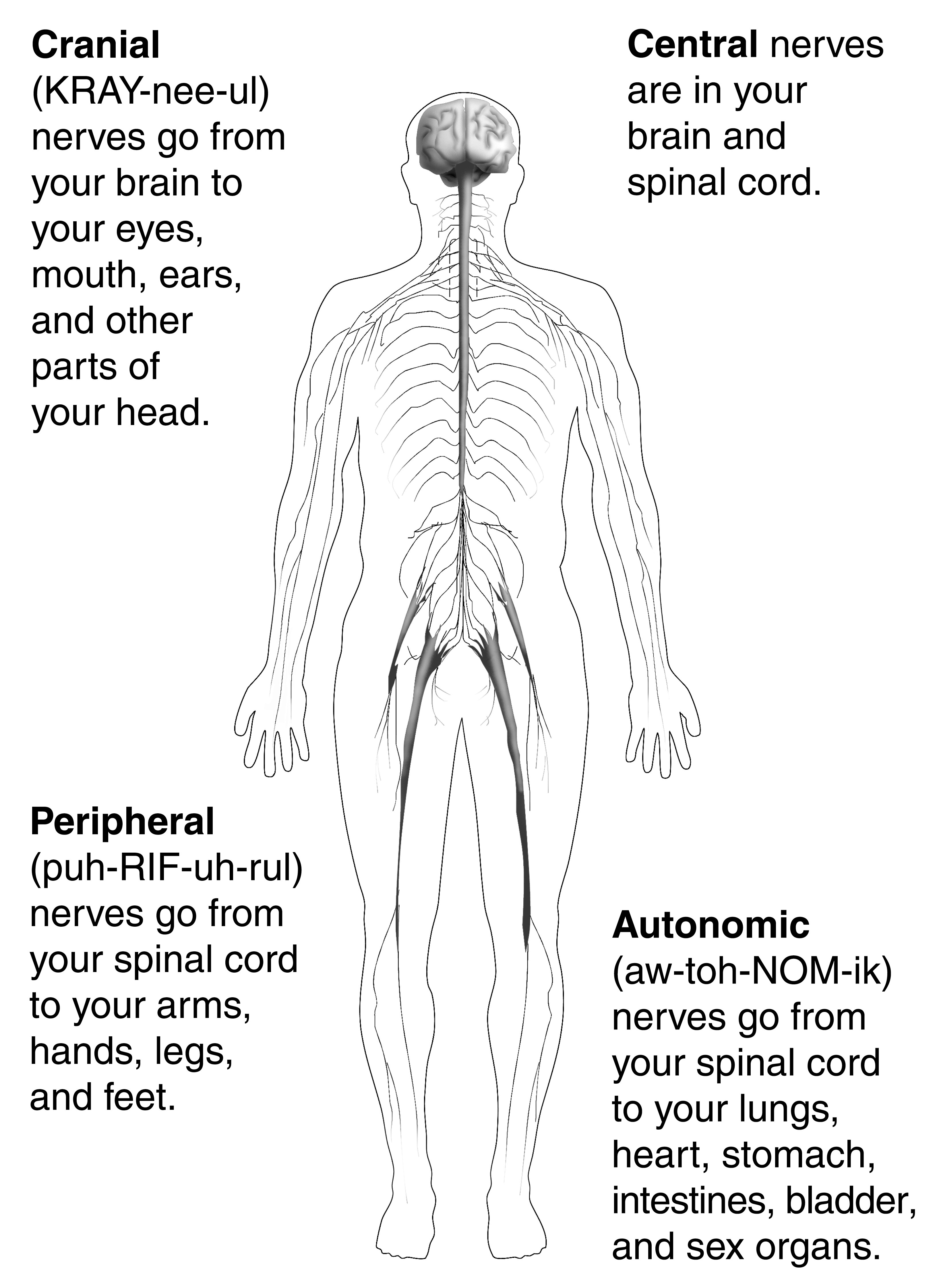
This illustration shows nerves extending throughout the body and identifies several major categories of the nervous system.
Sensory pathways carry information from peripheral receptors toward the central nervous system.
Motor pathways carry signals away from the central nervous system toward target tissues.
Somatic motor pathways include connections between the nervous system and skeletal muscle.
Autonomic pathways regulate structures such as smooth muscle, cardiac muscle, and glands.
It provides the neural pathways that allow the brain and spinal cord to receive sensory information and influence tissues throughout the body.
Spinal nerves emerge from the spinal cord, while cranial nerves are associated with the brain and brainstem. Together they provide extensive communication between the central nervous system and the body's periphery.
Spinal nerves connect with the spinal cord and carry sensory and motor information to and from regions of the body.
Cranial nerves are associated with the brain and brainstem and provide pathways to structures of the head, neck, and body.
A sensory signal may begin at a receptor in the body, travel through a peripheral nerve, enter the spinal cord, and continue toward brain regions that process the information. Motor signals can travel toward peripheral targets in the opposite general direction.
Knowing whether a structure belongs to the central or peripheral nervous system gives you an anatomical map. It allows you to place individual nerves into the larger organization of the nervous system.
The peripheral nervous system provides the connections between those central structures and the rest of the body.