The Spinal Cord
Discover the structure that forms a major pathway between the brain and the rest of the nervous system—and one that can also coordinate rapid reflexes.
A major communication pathway
The spinal cord is part of the central nervous system and lies within the vertebral canal. It provides pathways for information traveling between the brain and peripheral nervous system and contains circuits involved in reflexes.
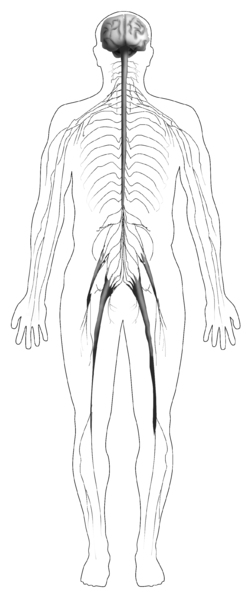
The spinal cord in context
Seeing the spinal cord as part of the whole nervous system helps explain why it is such an important connection between the brain and body.
Ascending information
Sensory information entering the spinal cord can travel through ascending pathways toward the brain.
Descending commands
Motor pathways can carry information from the brain through the spinal cord toward lower motor neurons and peripheral targets.
Rapid responses
Some reflex responses can be coordinated through circuits within the spinal cord.
Vertebral column
The spinal cord is protected by the vertebral column, meninges, and cerebrospinal fluid.
The spinal cord is both a pathway and a processing center.
Thinking of it only as a "cable" misses an important part of its anatomy. Spinal circuits can participate directly in reflexes and other neural processing.
Inside the spinal cord
A cross section of the spinal cord reveals gray matter surrounded by white matter. The gray matter contains many neuronal cell bodies and is organized into regions associated with different functions, while white matter contains pathways carrying signals up and down the spinal cord.
Following a signal
A sensory signal can begin at a receptor in the body, enter a peripheral nerve, reach the spinal cord, and then travel toward the brain. A motor command can follow a pathway in the opposite general direction toward a peripheral target.
Why reflexes matter
A reflex provides a useful example of nervous-system organization. A stimulus can activate sensory receptors, information can enter the spinal cord, and a motor response can be generated rapidly. The brain can also receive information about the event.
Fast does not mean simple.
A rapid reflex still depends on organized sensory neurons, interneuronal circuits, and motor pathways working together.